Breakout Sessions Descriptions & Categories
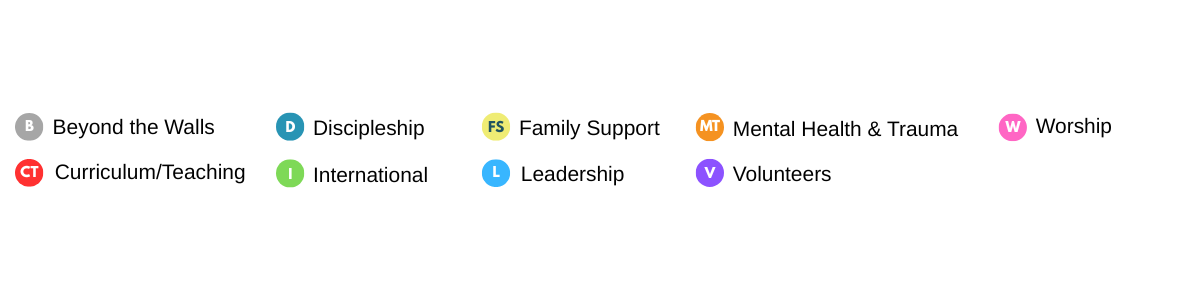
QUICK LINKS:
BLOCK #1
BLOCK #2
BLOCK #3
BLOCK #4
BLOCK #5
BLOCK #6
BLOCK #7
BLOCK #8
BLOCK #9
Breakout Block #1
Workshops
| TITLE | DESCRIPTION | PRESENTER(S) | CATEGORY |
| (At Least!) 10 Wins for Relational Ministry with Teens & Adults with Disabilities | Are you ready to have some wins in disability ministry? In this fun and practical session, we’ll explore (at least!) 10 ways to build authentic and reciprical friendships with teens and adults with disabilities. Learn how to break down barriers, foster true belonging, and create a culture where everyone is genuinely invited in. You’ll discover practical ideas for serving alongside one another, growing together in faith, and having fun in everything you do. Whether you’re a ministry leader, volunteer, or just getting started, you’ll leave encouraged and equipped with fresh strategies to strengthen the relationships that matter most. | Christine Boyle | D |
| A Call for Digitally Accessible Discipleship | Digitally accessible Biblical curriculum empowers diverse learners to engage in discipleship together, utilizing flexibility of learning and readily available assistive technology. Very few Biblical digitally accessible materials exist. In this workshop, participants will learn the benefits that digital curriculum offers to diverse learners and become familiar with accessibility features available to all. | Charla Holst | CT |
| Bearing Burdens: A Call to Heal Trauma with the Church | Explores how faith communities can become safe & restorative spaces for those carrying invisible wounds. Definies trauma & its impact on body, mind, and spirit, emphasizing that healing requires both compassion and understanding. Participants will learn how the Church can embody Christ’s model of empathy, presence, and shared suffering. Practical strategies are offered for implimentation. | Madeline Stiers | MT |
| Beyond Hyper-Cognitive Discipleship: Rethinking Spiritual Formation for Persons with Intellectual Disabilities | This workshop invites participants to rethink discipleship beyond intellect and language. Together we’ll explore how Christian spiritual formation can include people of all cognitive abilities, drawing on disability theology, the call of Matthew, and Bonhoeffer’s vision of community. Through discussion and reflection, participants will identify non-cognitive pathways for growth—such as shared presence, embodied worship, and mutual belonging. Key takeaways include recognizing how grace transforms beyond comprehension, reimagining inclusion in church practices, and developing formation models grounded in belonging rather than understanding. | Andrew Barron | D |
| Celebrating Disability & Diagnosis Before and After Birth | Inclusivity begins before birth, because one can’t be included who was never allowed to live. With nearly one in six pregnancies affected by a disability or diagnosis, the Church’s role in welcoming these families has never been more urgent. In this hands-on session, church leaders will be equipped to act as a bridge between the pro-life movement and disability ministry through three actionable steps: Welcome, Support, and Respect. Using the imagery of King David’s Table in 2 Samuel, the Banquet Table in Luke 14, and the Lord’s Supper, participants learn step-by-step strategies to celebrate families facing a diagnosis, build sustainable care systems, and empower disabled parents as leaders within the Body of Christ. | Jerry & Joan Borton and Chelsey Painter-Davis | FS |
| Creating a Space Where You Can See Learning Happening | Ever spend tons of effort for a ministry program only to wonder if it actually helped anyone grow in Christian maturity? It can be really hard to see change in congregants’ lives. How can our ministry efforts have more impact? How can we more quickly design educational experiences for all our learners, even when we don’t understand their developmental levels well? In this workshop, we will explore practical implications of some researched theories about how people learn best. Then we will practice using a couple simple, but profound, tools and a few key teaching methods to help us create meaningful teaching-learning processes and be able to clearly observe learning and change in the participants. | Tasha Chapman | CT |
| Creating Choice: Building Christ-Centered Education for Students with Disabilities in Private, Christian Day School | Every child deserves the opportunity to learn in a Christ-centered environment. This session will explore how Christian schools can create inclusive programs that welcome students with disabilities while upholding academic excellence and biblical truth. Learn practical steps to build a program that offers families real choice and reflects God’s heart for every learner. Together, we can make Christian education accessible to all. | Lauren Hickman | B |
| Creating Serving Opportunities for Adults with Disabilities | This session will guide leaders in developing systems that empower teens and adults with disabilities to serve meaningfully in their local church. Using examples from West Ridge Church’s World Changer and Team Inspire programs, we’ll explore how to match gifts with ministry roles, provide coaching and support, and foster true inclusion. Learn how structured volunteer pathways, job supports, and ministry partnerships can help individuals with disabilities become vital members of the church body—serving with purpose, dignity, and joy. | Jillian Palmiotto & Hollie Feathers | D |
| From Stigma to Support: How Every Believer Can Champion Mental Health in the Church | Churches are filled with compassionate people who want to help—but most don’t feel equipped to respond when someone is struggling with mental health. This interactive workshop offers practical tools and insights drawn from Anchor International’s Mental Health Champions training. Participants will discover simple, Christ-centered ways to recognize signs of distress, respond with care, and begin building a culture of compassion and belonging within their congregations. Attendees will leave encouraged, equipped, and inspired to take the first steps toward a stigma-free church community. | Kimberly Britt | MT |
| Starting a Disability Ministry in Any Sized Church | Has God called you to start a Disability Ministry at your church, but you don’t know where to begin? Whether you are a small church or a large one, this workshop will answer the questions of how, what, and why. Learn different classroom environments, types of behaviors, engaging and partnering with church staff and community organizations, and helping your church become an inclusive place for those with special needs. After this workshop, you will realize that YOU can do disability ministry at your church! | Doc Hunsley | CT |
| The Special Needs Parent-A Guide to the Life You Never Expected; Let Us Be Your Guide! | Joe and Cindi will be your guide as they build an itinerary traveling through some chapter titles of their new book (The Special Needs Parent-A Guide to the Life You Never Expected) which in part will include: Is God in this? It seems so unfair. The Stress…the need for making time for free time and fun and the how. “Everyday changes every day” with ways to become resilient. Our need for people on this journey: teamwork, relationships, and family. Unkind people and their words – how to deal with it (lovingly). Between the ledger of finances and its impact on our life both short and long term. The impact of death and on-going grief. The need to live a surrendered life to the Lord. | Joe & Cindi Ferrini | FS |
| Autism 101: Why Worship Can Be a War | For the autistic person, much of life can feel like trying to function in a war zone…that often includes trying to function in the worship hour. Why is that and how can we help? In this workshop Lori Sealy will share her personal perspective on living as an autistic individual. She will define what autism is, describe what autism is like (at least in her experience), and help you decipher what people with autism most desperately need. The goal is increased understanding that will lead to increased compassion as you seek to walk alongside autistic worshippers. | Lori Sealy | W |
Quick Takes
| Preparing the Soil for Spiritual Growth – Kim Botto | When kids don’t feel safe, their brains move into survival mode—making it hard for them to hear or trust what we say. Before the seeds of the gospel can grow, a child must first feel safe. This session explores how emotional and relational safety prepare the soil for faith to flourish. Through simple shifts in tone, environment, and presence, we can help children move from fear to trust, from self-protection to openness. When a child feels safe with us, they begin to believe they can be safe with God too—and that’s when true spiritual growth begins. | D |
| Who is Your Neighbor? Connecting Local Churches and Group Homes – Victoria White | People with disabilities living in adult foster care group homes are quietly nestled in our neighborhoods and sorely under involved in our local churches. To actively express our need for each one, neighborhood churches have the opportunity to be the voice of the Body saying, “we need and want you, and are one body with you.” In ten minutes discover a dozen ways to engage locally in body building with neighbors living in group homes. | B |
| From the Margins to the Kingdom: A Pattern for Inclusion from the Ministry of Jesus – Chris Hulshof | In John 4:1-42, Jesus encounters a marginalized woman at a well. Over the course of this encounter He will engage her so that she moves from cultural outsider to kingdom citizen. In this encounter Jesus gives us four steps to moving someone from the margins to the kingdom. This presentation will explore these four steps, draw attention to the theological heart behind each steps, and suggest ways that churches today can follow the methodology of Jesus practiced in this passage. | L |
| Excited or Scared? A Theological Look at AI from a Disability Lens – Matthew Mooney | There is real promise and potential within AI for those with disabilities. However, there are also real dangers. How can the church think theologically about AI and how does it reveal our theology as well as necissitate the church’s thinking and preparation as well as its particular impact upon those experiencing disabilities. | L |
Breakout Block #2
Workshops
| Advocating Like Jesus | Advocacy is a topic all-too-familiar to individuals and families touched by disability, and those who journey alongside of them. Advocacy elevates the voices and interests of people who would otherwise not be heard. That said, have you ever thought about what the Scripture teaches about Jesus as our Advocate? What can we learn about Jesus’ example, his end-run, and his engagement with people and how that can inform our advocacy to be more Christ-like? | Steph Hubach | D |
| Christian Myths About Mental Health | Many Christians have inherited poor theological frameworks and beliefs when it comes to mental health. These beliefs inhibit those battling mental illnesses from grabbing hold of the momentum that is so necessary to develop healthier life patterns and habits. Even worse, these myths can bury mental illness strugglers with guilt and shame. n this session, we will identify four myths about mental health that infiltrate Christian spaces. Then, we will outline how to counteract these myths with truth from Scripture. | Chris Morris | MH/T |
| Dynamics of and Strategies for Families in Crisis | Divorce, depression, abuse, even suicide plague families caring for our most vulnerable members of society. Isolated and misunderstood, many have turned their back on God and His Church. So how do we understand and minister to these families? Go deep in this hour through interactive teaching, testimony, and transformation. Walk away with tools you can immediately put to work building bridges, fostering compassion, and helping families discover the very real and saving presence of Jesus. | Mary Tutterow & Roena Clarke | FS |
| Grieving the Diagnosis | Grieving a Diagnosis: The Hidden Truths explores the emotional and spiritual journey parents and caregivers face after receiving a life-changing diagnosis for their child. Jeanetta Bryant shares her personal experiences and professional insights to help families, pastors, and educators recognize that grief in this context is not about loss of love—but the loss of expectations. The session helps participants identify the stages of grief unique to the disability journey and offers practical steps toward acceptance, peace, and renewed purpose. With compassion and honesty, Jeanetta reveals how faith can anchor families through uncertainty and guide churches to respond with empathy and understanding. | Jeanetta Bryant | FS |
| Keeping Ministry Safe For Everyone | In this workshop, we unpack the risk management process—a proactive, faith-based approach to creating safety within your Disability-Inclusive Ministry. Together, we’ll explore nine practical strategies to identify, prevent, and respond to the most common risks in ministry settings, ensuring that every individual can participate and serve with confidence and care. Because safety doesn’t happen by accident. | David & Samantha Jones | C/T |
| Salvation for Kids with Disabilities: Sharing the Gospel with Clarity and Compassion | Parents and ministry volunteers often ask, “Can my child with a disability understand the gospel?” The answer is yes because God meets each of us right where we are. In this encouraging session, we’ll talk about how to share Jesus in ways that match each child’s developmental and communication needs. You’ll learn to recognize signs of spiritual curiosity, respond to faith questions, and trust God’s work in every child’s heart. | Sandra Peoples and Jana Magruder | D |
| Self-Regulation Insights | This is a fast, hands-on workshop that turns good intentions into consistent follow-through. We distinguish self-control (choice) from self-regulation (capacity), then install a visible pause using simple, sensory cues. Parents learn a role-playing approach for neurodiverse teens to externalize decision steps, so kids can see it, say it, and do it. Short, coached reps build automaticity and confidence. Each participant creates a one-page Micro-Plan (trigger → options → values → next step). You’ll leave with a decision tree, a values-to-action script, and a 2-week home practice that reinforces wins, reduces friction, and strengthens the brain’s “calm-then-choose” pathway. | Joel Sheagren & Steve Fitzhugh | FS |
| Shepherd the Wounded: Trauma-Informed Children’s Ministry | Learning Objective: Participants will become familiar with signs & symptoms of trauma and the direct implication on ministry. Participants will have a greater understanding of shepherding hurting children. Participants will define trauma and will identify 2-3 trauma-informed practices they can apply in their children’s ministry. Participants will gain insight to hurting children resources. | Michelle Maris | MH/T |
| The Whole Picture: Integrating Disability Ministry into the Fabric of Church Life | We invite you to nurture and shepherd “Team Disability Ministry” in your church. God has designed this team by gifting and equipping each member with a unique piece of the puzzle. Who are the members? The members of this team are individuals with disabilities, parents, caregivers, and ministry leaders. The goal is that people with disabilities and their parents and caregivers are fully grafted into body life. This is church life. Join us as we share five practical, doable, and proven action steps your team can begin implementing right away to move your ministry from vision to full-body inclusion. | Tom, Julie & Amy Meekins | D |
| Trauma-Informed & Neurodivergent-Sensitive Worship | In this workshop, we explore how neurodivergent and disabled believers challenge common assumptions about what it looks like to be a disciple of Jesus. Participants will examine how these differences invite the church into greater freedom, creativity, and depth in spiritual formation. We will also discuss practical ways pastors and leaders can create environments where disabled/neurodiverse believers can flourish in their faith. Understand how neurodivergent traits can enrich our vision of discipleship. Learn strategies to cultivate ministry environments that honor individual ways of following Jesus while upholding scriptural fidelity. Identify practical steps to support diverse learning, prayer, and worship practices in your congregation. | Josh Davis | W |
| What You Can’t See: Decoding the Sensory System | What You Can’t See: Decoding the Sensory System is designed for anyone wondering about the brain-body experience and invisible disabilities. So often, we must play detective to understand what someone is communicating through non-verbal cues. Through real-world examples and visual demonstrations, we explain how the sensory system works, why everyday environments can overwhelm, and how these responses may appear as behavior. Participants learn practical tools to create calm, inclusive spaces, support regulation before crisis, and increase meaningful participation. The goal is shifting from reacting to behavior to truly understanding the brain-body experience. Learning this unseen world is vital to interacting with and caring for every person with dignity. | Candice Coker and Jessica Princell | C/T |
| With Purpose – Supporting Missionary Families With Disabilities | Our presentation will unpack our unique model for supporting missionaries impacted by disabilities and other unique needs. We take an integrative and collaborative approach to offer a unique week of respite, connection and resourcing to families, offering 1:1 buddies as well as a therapeutic team available for consults and support. We will also present on why this is needed, the unique challenges that these individuals face, ways churches and senders can support them on and off the field, and resources to support these families so that they would not just survive but truly thrive! By showcasing what our ministry does we hope to help all churches be more open to the idea of missionaries with disabilities serving globally, not inspite of their disability but because God uniquely gifted them! | Jasmine Tell & Doug Babbitt | INTL |
Quick Takes
| Disability and Medical Assistance in Dying (MAID) – Andrew Barron | In 2016, medical assistance in dying (MAID) became legal in Canada, transforming how Canadians think and talk about death, suffering, and care. This 10-minute quick take invites participants to assess the theological implications of euthanasia, with special attention to the experiences and perspectives of people with disabilities. | L |
| Four Principles of a Welcoming Congregation – Milton Keys | To become a welcoming congregation for people with disabilities, it’s essential for the entire community to abandon stigma and inflexibility. In this workshop, Rev. Dr. Milton Keys explores Mark 2 to identify four vital attitudes that foster a welcoming church. Join us to learn how to equip your congregation to become a supportive and inclusive community, ensuring access and empowering people with disabilities to take on leadership roles within your church. | L |
| Sensory Bags: an Easy Tool to Support Families – Janell Petersen | What is a sensory bag and why should they be used? This quick take will walk you through on how to implement a sensory bag program at your church. This simple, inexpensive tool can make a big difference—helping individuals feel more comfortable and sending a powerful message of welcome and support to the disability community. | CT |
| Seeing Our Families Whole: A Teen’s Guide for Churches on Disability, Faith, and Belonging – Hannah Hardy & Montreece Hardy | Seeing Our Families Whole: A Teen’s Guide for Churches on Disability, Faith, and Belonging shares Hannah Hardy’s experience as a child of a disabled parent and the hidden challenges such families face in faith communities. Grounded in 1 Corinthians 12 and youth mental health research, it examines the emotional impact of being overlooked. The presentation offers practical strategies to help churches move from basic support to true inclusion and belonging. | FS |
Breakout Block #3
Workshops
| A Look Inside: A Parent Panel of Stories & Insights | This panel offers a candid look inside the lived experiences of parents raising children impacted by disability. Through personal stories and shared wisdom, parents reflect on challenges, growth, and what meaningful support from the church truly looks like. | Sarah Broady, John Fela, Anthony Peterson and TBD | FS |
| Accessible Youth Ministry: Promoting the Faith Formation of Youth with Disabilities | Like anyone else, youth and young adults with disabilities, mental health challenges, and chronic illnesses need to explore, share, and deepen their faith within a caring and committed community. The Bridges to Belonging project seeks to equip churches to pursue and embrace young people in ways that promote spiritual growth and belonging. In this session, participants will learn practical tools to support youth and emerging adults with disabilities, including ways to reflect on barriers, reimagine Christian spiritual practices, and engage all young people in their ministries. Participants will learn practical strategies for increasing accessibility in youth ministry gatherings and encouraging practices that promote the faith formation of youth with disabilities. | Elyse McMullen & Bailey Thompson | D |
| Breaking Barriers to Belief: Discipling Kids Who Learn, Think, and Feel Differently | Every child is created to know and experience God’s love—but for kids impacted by disability, trauma, or neurodivergence, traditional discipleship models can be ineffective. This workshop helps leaders and volunteers identify the barriers that may keep kids from fully engaging in their faith and offers creative, accessible ways to share the gospel. You’ll leave with practical tools to teach, connect, and disciple kids in ways that honor their unique wiring and background, reflecting God’s heart for belonging. | Kim Botto | D |
| Dignifying Lament: Normalizing Authentic Expressions of Difficult Emotions | For those living with disabilities and those who care for them, working through loss and emotional pain is essential to experiencing the life of flourishing to which God has called us. Unfortunately, this grief process has often been misinterpreted as a lack of faith, when the opposite is true. From David to Jesus, the Bible is full of examples of heroes of the faith who expressed lament in difficult times. Not only did they find comfort and relief in releasing their genuine feelings to God, but they found renewed strength and peace as they recalled His faithfulness. This session will prepare leaders to equip hurting people to communicate their pain to God without reservation. | Allison Hampton | FS |
| Held in the Love of God: Discipleship and People with Profound Intellectual Disabilities | Employing thoughtful theological reflection, I will argue for a broader theology of discipleship within evangelicalism that includes the spiritual lives of people with profound intellectual disabilities. I will explore evangelical discipleship in a way that provokes theological inquiry, while also leading local congregations, pastors, and lay leaders to consider implications for ministry. | Phil Letizia | D |
| How to Adapt Curriculum: From No-Prep Strategies to App-Based Options | Learn practical ways to adapt Bible curriculum for children with disabilities, whether you have no prep time or want to incorporate interactive apps. Discover strategies that match your children’s needs and your ministry’s resources. Leave equipped with ideas you can use immediately, from quick printable visuals to tech-based supports that engage every learner. | Laura Deeken & Katie Matthews | C/T |
| Shepherding Towards Wholeness: Building Resilient Leaders and Healthy Churches | Pastors, ministry leaders, and volunteers are called to care for others, but many carry unhealed wounds from their own stories that can quietly affect their ministry and mental health. This session, based on the ebook Shepherding Towards a Healthy Ministry, explores how Adverse Childhood Experiences (ACEs) influence pastoral resilience and leadership. Participants will use the latest data to learn about ACEs and traumas for church leaders, how to recognize the signs of burnout, develop healthy rhythms, and create trauma-informed church cultures. Together, we’ll explore how faith and mental health intersect to form stronger, healthier ministries that reflect the wholeness of Christ. | Jeremy Smith | MH/T |
| The Church’s Response to The Anxious Generation | The Anxious Generation by Jonathan Haidt is the most discussed analysis of the youth mental health crisis. Attendees will review findings presented in Dr. Haidt’s book and consider how local churches might join parents, educators, professionals and government in facilitating effective responses to the mental health epidemic. Specific topics include communication of parenting practices most likely to promote resilience and positive mental health, the benefits of church as a place where children and adults can regularly experience embodied Christian community, the role of the church in facilitating collective action to limit the adverse effects of smartphones and social media on mental well-being, and the promotion of worldviews and spiritual practices associated with positive mental health. | Stephen Grcevich, MD & Rachel Medefind | MH/T |
| The Rules of Engagement from City Hall to the White House | As government programs for disabled people of all ages become less available and protections become less reliable, it is going to be up to the Church and parachurch organizations/ministries to step into the gap to fill the need for advocacy and hands on care. This session will cover appropriate interactions with elected officials and bureacrats on all levels of government. Attendees will be given scripts to use for written contact and step by step instructions on how to get the appointment with the desired office. They will also be given samples of papergoods to use. | Melissa Ortiz | B |
| Uniquely SHAPE’d to Serve | Each of us has been Uniquely SHAPE’d to Serve by our Creator. In this session, attendees will be guided through an interactive approach to help them discover their God-given SHAPE. Adapted from Rick Warren’s teaching in “The Purpose Driven Life”, SHAPE covers individual (S) spiritual gifts, (H) heart passions, (A) abilities, (P) personality, and (E) experiences. Understanding your unique SHAPE will help you determine how and where God wants you to serve. SHAPE training is beneficial for students (high school and above), staff members, volunteers, and parents; people with or without disabilities. We have each been created by God on purpose and for a purpose and as we understand our unique SHAPE, that purpose becomes more clear. | Tracy & Becci Terrill | D |
| What Parents Wish Churches Did: From Research to Practice in Disability Ministry | What do families living with disability actually wish churches would do? Baylor University recently conducted research with parents to uncover their hopes, needs, and expectations when it comes to disability ministry. This session will share the key themes and wishes that emerged from those conversations, offering a rare and research-based window into the experiences of these families. Building on those findings, the session will provide practical, realistic ideas for how churches of all sizes can begin implementing these wishes in their own context. Participants will leave with actionable steps, ministry strategies, and mindset shifts that reflect what families are truly asking for. This research-to-practice approach will help churches move from good intentions to meaningful inclusion. | Kristin Langford, Abigail Roe de Silva & Cindy Utama | FS |
Quick Takes
| How Developing an International Partnership at DATC2026 Can Help Your Ministry to Grow – Alfonso Feria | God is doing some amazing Disability Ministry work outside of North America in 2026! I had the opportunity to do 3 different international Special Needs Ministry short-term mission trips in 2025 in Zambia, Albania & France. All these trips came out of simple conversations and connections during the DATC2024 and DATC2025 conferences. The goal of this QuickTake is to motivate you during DATC2026 to have a conversation with someone here doing ministry outside of North America and build a connection with them and see where that takes you. | I |
| Disability Inclusion in Africa – Ruth Bullock & Rachel Gondwe | The presentation will highlight both the joys and the challenges of working in disability ministry within Africa. Encouraging disability awareness and disability inclusion looks very different in the African context with limited resources but we can share stories about what God is doing through establishing inclusive mission and churches through training and coaching in disability awareness. | I |
| Fifteen Years of Innovative Disability Ministry in Sub-Saharan Africa – Holly Nelson | In 2010, many children with intellectual disabilities in Zambia were hidden away or abandoned. Today, thanks to training for parents and communities, perceptions are changing. Disabilities are no longer always seen as a curse or contagious. As families and communities learn the facts and effective teaching methods, inclusion is growing, and Zambia is becoming more welcoming. Training all the adults in a child’s life creates lasting change and builds community support. The gospel is reaching families once excluded from churches, and over 15,000 children and caregivers have been trained so far. We’re eager to share what’s worked so others can do the same in their countries. | I |
| All The Nations – Marcus Smith | Putting hearing people in the shoes of deaf people with a social experiment. (Signing with not voice interpreter). Dissect Matthew 28:19–20 “All Nations” includes Deaf and hard of hearing. Understand the Deaf experience many are isolated from birth parents don’t know ASL. Unpack what healing looks like, let us seeking healing of the heart, mind and soul not the ears. | I |
Breakout Block #4
Workshops
| After the Kids’ Ministry Ends: Creating Space for Adults with Disabilities to Belong | Too often, disability ministry ends when childhood does—but faith development doesn’t stop at graduation. In this hands-on session, you’ll learn how to build a thriving adult ministry that goes beyond care to create true community and purpose. Discover practical steps for helping adults with disabilities grow in their faith, use their spiritual gifts, and find meaningful roles in the Body of Christ. You’ll walk away equipped with tools, ideas, and inspiration to make your ministry more inclusive—for every stage of life. | Ryan Wolfe | CT |
| Be Mighty in Prayer: A Biblical Framework for Church Leaders to Equip Moms Raising Children with Disabilities and Medical Complexities | Prayer can feel impossible for moms of children with disabilities or medical complexities. Ash Dion shares the Be Mighty in Prayer Framework, a Scripture-based tool helping moms bring honesty, courage, and hope to God. Leaders will learn to guide parents, equip them to reconnect with God, and provide a repeatable resource for support and ministry. | Ash Dion | FS |
| Building a Culture of Inclusivity: Four Pillars That Shape a Church of Belonging | Building a truly inclusive church requires more than a special-needs classroom—it demands a culture shift. This session will explore The Four Pillars of Inclusive Church Culture: Language, Visibility, Accommodations, and Relationships. Pastors and ministry leaders will learn practical ways to embed these values into every ministry area, helping their church reflect the full Body of Christ. Building a culture of inclusivity will ensure that individuals and families impacted by disabilities will be accepted as important members of the church family in a uniquely organic manner. Participants will leave equipped to lead a culture where every person is seen, valued, and included as God uses the local church to fulfill the Great Commission. | Bobby Howard | L |
| Building Spaces for Healing through Trauma-Informed Ministry | When children have experienced trauma, their behavior often communicates pain more than defiance. This session equips ministry leaders and volunteers with a trauma-informed lens that transforms how we see and respond to hurting kids. We’ll explore how trauma impacts the brain, relationships, and faith—and what that means for ministry. You’ll gain practical tools to help kids move from survival to connection and from chaos to calm. When our ministries are grounded in safety, consistency, and compassion, we create spaces where healing begins and faith can grow. | Kim Botto | MT |
| Creating a Caring Church: Outcome Research and Proposed Methods to Address the Mental Health Crisis | When mental health systems are overwhelmed, the church can respond with compassion, presence, & hope. People are lonely, exhausted, and spiritually disoriented. The Church doesn’t need to become a clinic, it needs to become a community of care. This session shares data from a national survey of 1,952 pastors, leaders, and counselors, along with insights from 100 interviews. They reveal a picture of what works when it comes to building mental health ministry. You will gain: • A biblical framework for human care • Tools to equip volunteers and protecting pastors from burnout • Encouragement that you don’t need to do everything, but can start something. Care can lead to discipleship. The Church can focus its mission as a place where the hurting find hope, and where no one walks alone. | James Sells & Jennifer Ripley | MT |
| Creating a Volunteer Pipeline for Disability Ministry | This session will help ministry leaders build a strong volunteer pipeline for disability ministry. We’ll explore practical strategies for recruiting, training, and retaining dedicated volunteers, while fostering a culture of inclusion and purpose. Learn how to identify and develop key volunteer roles—from buddies and teachers to sensory support and administrative leaders—and discover innovative ways to keep your team engaged, equipped, and growing so you always have the right people in place to meet every need. | Jillian Palmiotto & Hollie Feathers | V |
| Disability Ministry Across Cultures: Stories & Strategies | How can we do disability ministry when culture, language, and worldview differ from our own? Through stories and strategies from cross-cultural contexts, participants will be inspired with hope and equipped with practical steps for building inclusive communities that reflect God’s heart for His global church. | Christina Marini | INTL |
| Disability VBS Workshop: Everything You Need to Host an Inclusive VBS | Learn how to help your church host Vacation Bible School events that welcome and support participants of all abilities. This interactive session will equip you with the knowledge, strategies, and tools needed to create an inclusive, accessible, and joyful VBS. Each breakout attendee will receive a complete VBS Disability Inclusion Toolbox—a ready-to-use package filled with resources, communication aids, volunteer training guides, and more. We will walk you through everything you need to confidently host an accessible and welcoming VBS. | Katie Matthews & Shannon Diehl | CT |
| From Calling to Community: Launching Christ-Centered Day Programs | Inclusion is not a program—it’s a posture, and the Church is called to lead the way. This session explores how the need for a Christ-centered day program was recognized—and why these programs are deeply important, while also not being the only answer. Participants will learn how to discern the unique needs of their communities, develop a vision rooted in dignity and belonging, and prepare churches to move from good intentions to meaningful engagement. Attendees will leave encouraged and equipped with practical, actionable steps to inspire support, mobilize their congregations, and take faithful action in their own context. | Hadley Stephens | B |
| Leading through Lament: When Leadership and Loss Share the Same Season | What happens when leadership and loss collide? When you’re still grieving, still exhausted, still praying for breakthrough, and people are still looking to you for strength? This breakout explores what it means to lead through heartbreak, not around it, and how leading through grief can shape and strengthen the way you shepherd others. This will be a testimonial style teaching from our personal journey of leading a church while navigating loss and disability parenting, pointing to biblical truths of God’s heart surrounding brokenness and his ability to redeem it all for His greater purpose. | Luke & Leia Davis | L |
Quick Takes
| From Stigma to Belonging: How Peer Support Can Transform the Church – Kimberly Britt | I grew up in church, but never felt I belonged while silently struggling with trauma and mental health challenges. My life changed when I experienced Christ-centered peer support—a community that loved me as I was. Now, through Anchor International, we’re helping churches create that same culture of care by equipping everyone to offer informed support, not just leaders. Because when we equip everyone to be a peer supporter, we don’t just start programs—we start a culture shift. In this talk, “From Stigma to Belonging: How Peer Support Can Transform the Church,” I’ll share how empowering whole congregations can transform the church into a place of support, compassion, and true belonging. | MH |
| We Are Chosen For This – Elizabeth Coulter | Since starting the non-profit, Louie’s Huwe, for my son, we have funded a drug trial which can potentially cure children with his type of epilepsy. This would never have been done without the support of our church. The world tells us that we should be angry when people say, “God made special people for special kids.” I disagree. I take it as an assignment. I and my church were chosen for this life. With the support of our church, we will continue to glorify God through the research and progress we make at Louie’s Huwe. God hand picked me to advocate for my son because he was created in God’s image. Our church has been present for every fundraiser, every YouTube video, every social media post that needed to be shared. I hope to encourage other churches to be the support for others. | B |
| 1 Timothy 4:8 “..physical training is of some value..” – Tony D’Orazio and Emily Kullman Ph.D | About 60 % of those with Down syndrome get Alzheimer’s Disease (AD). ASERIOUS MENTAL HEALTH ISSUE!! One of the treatments for AD is exercise. Our hypothesis; What if regular ongoing exercise could decrease the onset of AD in the DS population? Share our research and insights. Share our research on the positive aspects of exercise. | B |
| Solutions for Small Churches – Amberle Brown | When people think of “disability ministry”, they often think of an elaborate space with specialty equipment, a slew of professionals, and complex programming. For many, especially small or under-resourced churches, this vision overwhelms and halts any imagined possibility of disability inclusion. But we believe that no church is too small to include and embrace people with disabilities – in fact, we have seen many small churches integrate people with disabilities into the life of their church in a remarkable, creative, and simple way. This session will highlight simple, low cost solutions that congregations of any size can employ to make their church a place where people with disabilities know that they belong. | L |
| How to Start a Nonprofit – Kyle Vermeulen | B |
Breakout Block #5
Workshops
| A Model for Accessible & Inclusive Bible Study: Universal Design for Learning | Many people with disabilities are excluded from traditional Bible study due to a lack of accessibility. In this session, you will experience an accessible and inclusive Bible study with step-by-step instructions on how to meet diverse learning needs. Charla Holst, OTR/L, will explore the evidence-based Universal Design for Learning model as it is demonstrated for all to participate on their digital devices. Dr. Keys, disability theologian and co-author of the Act On His Word Bible Study, will examine the benefits of including people with and without disabilities together for discipleship. Angela Cushing, instructor of Special Ed/Theatre, and Bible Study leader will share her experience and answer questions. Hands-on-learning abounds as we explore over 50 accessibility features together! | Charla Holst, Dr. Milton Keys & Angela Cushing | CT |
| Approaching & Embracing Biblical Identity as a Mindset to Promote Disability-Inclusivity | Personal identity not only impacts how we view self, but also how we see, value, and treat others. The imago Dei principle tells us Who God is, but also tells us who we are. This presentation focuses upon the biblical lens of identity, beginning with Genesis 1:27. Disability-inclusivity requires an intentional mindset with a goal of reaching the largest minority and unreached group: the disabled. | Laurie Thompson | L |
| Bridge Builders: Connecting Church Disability Ministries with Local Schools | Church disability ministries can be deeply committed to supporting students with special needs, yet establishing genuine connections with local schools can be challenging. This workshop equips ministry leaders to build authentic, respectful partnerships with schools—particularly special education programs—to better serve students and families. Participants will examine shared goals between churches and schools, clarify appropriate boundaries, and develop practical strategies for support, ranging from volunteer engagement to sensory resources. Through interactive exercises, real-world examples, and an action planning tool, attendees will leave with concrete steps to foster trust, collaboration, and lasting impact in the lives of children. | Heidi Ravenscraft | B |
| Build a Sensory Room with Me | Sensory rooms don’t have to be expensive, overwhelming, or “Pinterest-perfect” to be effective. In this hands-on workshop, we’ll walk step-by-step through what it actually takes to create a sensory room that serves kids and individuals with sensory needs in a real church environment. Together, we’ll look at what matters most, what you can skip, and how to design a space that supports regulation, participation, and gospel engagement—whether you’re working with a dedicated room, a shared classroom, mobile cart or a corner of a hallway This workshop is all about building-it-with-you—so you can leave ready to take your next faithful, practical step toward welcoming individuals and families impacted by disability. |
Abby Howard | CT |
| Creating Co-Laborer Culture in Your Church: Changing Attitudes | Workshop through the 5 Stages of Changing Attitudes in an interactive conversation with the author of this tool and nationally-recognized ministry advocate. Develop your understanding of the Stages and how to follow Scripture to guide your journey through them. Together we will create a map to guide your own church through the journey so that your ministry with people with disabilities is theologically-grounded and practically equipped for the good work God has prepared for you all to do. | Victoria White & Dan Van Der Plaats | L |
| Disability and the Gospel: Why Disability Ministry is Integral to the Life of the Church | “Calling All Pastors!” Disability ministry is not the most important thing that the local church does. (That can be hard for disability advocates to hear!) But here’s the deal: disability ministry is integrally related to everything the local church does that is important! We’ll look at disability biblically, be honest about the challenges, explore the gospel implications, and then provide an essential evaluation to use to look at how your congregation is faring in making the gospel accessible to people with disabilities and their families. This session will help you as a pastor to integrate a gospel-centered focus into the very heart of disability ministry as they call their congregations to justice, mercy, and faithfulness. | Steph Hubach | L |
| Strengthening Faith & Belonging Alongside Families with Disability | Each generation in a family impacted by disability can face unique barriers to growing faith and fulfilling community involvement. We will explore how a structured and intentional conversation about strengths and challenges can lead to opportunities for meaningful befriending, discipleship and co-laboring. Ultimately, the church community can gain valuable perspectives while unlocking practical insights and the relational riches of inclusion and belonging. | Larry & Lisa Jamieson | FS |
| The Belonging Blueprint: Starting a Church Disability Network in Your Community | Across the country, networks are forming so churches of all denominations can collaborate and become places of belonging for people of ALL abilities. Be inspired by how God is using the network model to unite His people through the Masterpiece Alliance Church Network in Southwest Virginia, the Invited In Church Network in Cleveland, and the ministry of Joni and Friends. Gain practical tools and guidance for launching a church network in your area, and be encouraged by real-life stories of leaders who are learning to walk together as the Body of Christ – where every member belongs and every gift is valued. Discover how God can use YOU to equip leaders in your community to move beyond isolation and into collaboration—so together, our churches become places of belonging for ALL! | Scott Habeeb, Christine Boyle and Russ Duncan | B |
| The Power of Peer Support: Why It Matters and How to Build It | This workshop explores the transformative impact of peer support within faith communities and mental health ministries. Pastor Brad will share practical steps for launching effective peer-led groups, discuss the benefits of lived-experience leadership, and highlight how churches can empower individuals to support one another through hope, empathy, and shared experience. Attendees will leave with a clear understanding of the foundational elements needed to build a sustainable and life-giving peer support ministry. | Brad Hoefs | MT |
| Welcoming Starts Online: Accessibility Strategies for Church Websites | Many families check out a church’s website before they ever step through its doors, making the website the “front porch” of the church. This session will explore how churches can make their websites more accessible, inviting and inclusive for people with disabilities. Drawing on research conducted by Baylor Collaborative on Faith and Disability, we will share key findings about common barriers and opportunities in church website design. Participants will see specific features and strategies that promote welcome and inclusion, along with clear, actionable recommendations that churches of all sizes can implement immediately. Attendees will leave with tools to assess and improve their own online presence, ensuring their digital front porch welcomes everyone. | Kristin Langford & Jason Le Shana | L |
| Where Psychology Ends, Faith Continues | This session explores how psychology and faith work together to bring healing and wholeness to individuals and communities. While psychological principles help us understand the mind and behavior, faith speaks to the deeper needs of the soul that science alone cannot satisfy. Participants will learn how pastors, Christian counselors, church leaders, and congregation members can collaborate to provide care that is both clinically sound and spiritually grounded for the congregation and the community. Together, we will examine how the integration of mental health and theology creates a pathway for lasting transformation, where professional insight meets the hope and power of Christ. | Jeremy Smith | MT |
| Why the Neuroscience of Trauma Matters: How Understanding Trauma Leads to an Improved Path Toward Healing | In the faith community, there can be a potential to only focus on the spiritual aspects of mental crisis or to spiritualize mental health conditions. This approach limits the ability of healing which is why a holistic, whole-person focus is necessary. A holistic focus balancing spiritual, mental, emotional, and physical can accelerate healing of the whole person. In this workshop, we will discuss the purpose of faith/prayer, psychotherapy, and medications in mental crisis treatment and healing. From a medical provider, strong believer, and trauma and crisis focused AACC presenter, the attendee will learn a balanced, holistic-focused approach to mental crisis healing and walk away with actionable steps and resources to implement this approach in their church, ministry, and community. | Amber Parker | MT |
Quick Takes
| The Church Pew Isn’t Always Accessible – Nikki Baltusis | Many believers with hidden disabilities can’t simply “come to church.” Nikki Baltusis shares how churches can see the unseen and foster belonging—using both in-person spaces and online communities—to ensure every believer can experience Christ’s love and connection. | L |
| More Than Statistics: How Stories Can Shape the Heart of Your Church – Luke Davis | As ministry leaders, we long to see our churches truly welcome families impacted by disability, yet that vision isn’t always shared or fully realized. In this Quick Take, we’ll explore how the authentic stories of the people in your church can be powerful tools to grow your ministries, build stronger teams, and shape church culture. You’ll learn practical strategies for gathering, sharing, and responding to stories not as statistics or case studies, but as opportunities to foster empathy, strengthen relationships, and create inclusive spaces where all people are valued. | L |
| Beyond Limitation: Activating Gifts in the Disability Community – Amy Meekins | Every person—regardless of ability—is a masterpiece of God’s design, gifted for His purpose. Yet, it can be challenging to see how those gifts translate into active ministry roles. Stop searching for what’s missing and start seeing what’s possible. We’ll explore practical ways to reframe your perspective, identify overlooked talents, and create a ministry environment where every ability is celebrated and put to use. | L |
| Belonging Under the Bridge: Lessons in Disability, Worship, and Shared Flourishing from a Church without Walls – Melody Escobar | “Belonging under the Bridge” is a year-long ethnographic study funded by the Calvin Institute of Christian Worship. The project explores how belonging unfolds in the life and worship of Church Under the Bridge—an interdenominational congregation that has gathered beneath an Interstate highway in Waco, Texas, for three decades. Grounded in a framework of belonging that emphasizes being known, accepted, needed, and loved, the study examines how relationships, worship, and leadership practices sustain connection among people who are disabled, unhoused, and living in poverty. Findings reveal how intentional diversity, relational accessibility, mutual discipleship, and unconditional love cultivate a church culture of healing and shared dignity. | B |
Breakout Block #6
Workshops
| A Deeper Dive: What We Are Learning from New Research on Disability and the Church | The Baylor Collaborative on Faith and Disability has recently completed several large research projects on disability in the church. We are continuing to learn from the perspectives of pastors, ministry leaders, families, adults with disabilities, and more. We are also discovering how leaders engaged in disability ministry envision transformational movements in churches; both the goals and steps churches must commit to if they are to move in a more faithful direction. This presentation will incorporate insights from these projects to take a deeper dive into questions related to the practices and perspectives involved in becoming more faithful churches where people with and without disabilities flourish together. | Jason Le Shana & Erik Carter | L |
| Cooking Capable | A team of Cooking Capable volunteers present our testimony of how God got us to where we are today. The presentation includes Cooking Capable’s tips and tricks, how to meet individuals where they’re at, and dealing with the negative notations of disability and the kitchen. | Ivy Prince & team of volunteers | B |
| Equipping the Global Church for Disability Ministry through Training by Using a Participatory Method | CHE Disability training helps the global Church identify the problem of traditional beliefs about disability and equips the Church to create belonging for persons and families impacted by disability. Through training, participants demonstrate the ability to take ownership and initiate outreaches to the disability community in their own ministry contexts deciding for themselves what steps they will take. This workshop will introduce the participants to the approach to initiating a disability ministry in community development, the strategy of CHE Disability training and the participatory methodology used throughout training. The workshop participants will be able to understand, practice and start using the participatory methodology in their own ministry contexts. | Jenna & Guido Schmid | INTL |
| From Conference to Congregation: One Year of Inclusion in Action | After attending DOATC2025 Conference I applied the information learned at my church. It is amazing what God has done by just trusting Him while putting faith into action. This presentation will included our Executive Pastor, Children’s and Preschool director sharing the one year journey from a conference to an inclusive disability ministry. Attenders will learn practical ideas on how to get started and leave with resources and encouragement to build an inclusive disability ministry at their church. | Mike Thompson & Jason Hope | L |
| Small Steps, Big Impact: Including Serious Mental Illness in Your Ministry | This session invites church leaders and members to step past fear and misunderstanding toward families affected by serious mental illness (SMI). Through personal stories, biblical truth, and practical steps, we’ll explore how the church can respond with compassion rather than avoidance. Attendees will learn why SMI is not as intimidating as it seems and how the same principles already used to serve other vulnerable groups can be applied here. The goal: to equip churches to move toward, not away from, those living with serious mental illness and to offer lasting hope in Christ. | Deborah Geesling | MT |
| Stay or Go: Equipping Parents to Discern Church Decisions | Many families impacted by disability face a difficult question: Should we stay at our current church or move on? Whether staying means growing in grace and partnering with church leadership to move disability ministry forward or going means seeking a new place to belong, both require prayerful discernment and gospel-centered wisdom. This workshop offers a practical framework to help parents navigate that process while giving church leaders insight into the challenges these families face. Participants will leave with tools, discussion frameworks, and a decision rubric to equip families to engage faithfully and confidently in their church community. | Larah Roberts & Dr. Terisha Lee | FS |
| The Beauty and the Mess: Lessons Learned Leading Incarnational Ministry for and with Adults with Disabilities | Participants will gain an overview of what relational ministry for and with adults with disabilities looks like. This incarnational ministry approach mirrors the way we see Jesus engage with people in the scriptures. Walking alongside our community members through both the beauty and messiness of life, which is more challenging than building programs, we have found greater potential for meaningful discipleship and true co-laboring. For over three years, Masterpiece Alliance staff members have lived out this ministry model with adults with disabilities in Southwest Virginia. Hear their journey, learn from their challenges, and be reminded that we are blessed to be children of a God who cares deeply about every part of our lives—no matter how messy. | Paul Duffy, Mckenna Habeeb, Jordan Duffy, Silas Henderson, KJ Dinsbeer & Scott Habeeb | D |
| The Indispensable Image: A Gospel-Centered Theology of Belonging | While 99% of pastors believe their churches are inclusive, adults with disabilities remain a largely unreached group. This workshop argues the problem isn’t a lack of heart, but a flawed “charity model” theology. The gospel-centered solution: the “From Pity, to Dignity, to Necessity” framework. This memorable pathway moves beyond managing people with disabilities as projects and recognizes them as essential family members. We will ground Dignity in the Imago Dei—that all people possess unshakeable worth. Then, using 1 Corinthians 12, we will build a culture of Necessity, showing the church is incomplete without the presence and gifts of people with disabilities. Leaders will leave empowered with a biblical vision and practical tools to create a community of true belonging. | Nadia Mossburg | L |
| The Power of Praying Scripture in Disability Ministry | The Bible is a treasure trove of prayer possibilities, providing words that can align our hearts and our will with God’s. In this workshop, we’ll explore the practice of praying God’s Word and how Scripture-based prayer can: -bring strength, comfort, and hope to parents of children with disabilities -encourage and equip disability ministry leaders as they walk alongside families -help individuals with disabilities engage with God’s Word and grow in their prayer life. Whether you’re a parent, caregiver, or ministry leader, this workshop will equip you with biblical encouragement and practical tools to help yourself—and those you minister to—connect more deeply with God through Scripture-based prayer. | Jenn Soehnlin | D |
| Unapologetically Called: Living Your Purpose with a Disability | Learn from two Christian disabled leaders how to empower disabled individuals to live boldly into God’s purpose. This workshop provides practical strategies for ministry leaders, families, disabled individuals and church volunteers to foster teaching, discipleship, and belonging. Attendees will explore how to create inclusive spaces, strengthen faith, and encourage confidence and purpose-driven action in the lives of disabled members and their families of the faith community. | Tameka Citchen-Spruce and Allison Hampton | L |
| When Hurting People Come to Church: What Can Churches Do | We will present a brief description of how all churches can access the resources to The Church Cares Initiative. TCC offers comprehensive information of best practices in congregational and community care. The emphasis in TCC is not to create another program, but to demonstrate how churches can raise the competence level of everyone in church who interacts with others so that all are prepared to sit with another in pain. TCC provides resources, often in partnership with other mental health ministries, to train and provide tools as churches create ministry specific programs. | James Sells | MT |
Quick Takes
| Overcoming Barriers to Faithful Ministry – Shannon Eshman | Faith is important in the lives of many people with and without disabilities. However, religious participation for adults with intellectual and developmental disabilities (IDD) is proportionally lower. When churches do disability ministry well, it can help support the full participation of adults with IDD and help close this gap in participation. In this presentation, we present our findings about barriers to disability ministry from a study conducted at Baylor University. We hope that our presentation helps churches increase their awareness of potential barriers to disability ministry and that they can learn how to address some barriers they may face in their own church settings. | L |
| Let My Boys Stay Together: A Call for Inclusion in the Church – Nakoa Merritt | As a mom of twins, one with a disability and one without, I’ve spent years searching for a church where my children could worship and grow together. Many families share this longing to belong without being separated, to be seen without being set apart. This session invites ministry leaders to move beyond accommodation and weave inclusion into the very DNA of church life. Through my personal journey, I’ll share how shared worship, friendship, and discipleship can help every child grow in faith. Attendees will leave with renewed compassion and vision to build a church where every child belongs and knows they are loved by God. | L |
| Sustaining Ministry Through Boundaries and Balance – Brooke Garcia | Ministry thrives when leaders serve from a place of health, clarity, and balance. This session explores the critical role of boundaries and margins in sustaining effective disability ministry. Participants will be guided and encouraged to evaluate how their time, calendar, and mission align with their personal calling and ministry goals. Through practical strategies and reflection, learn how to prevent burnout, prioritize what matters most, and cultivate rhythms that promote long-term impact and well-being in both life and ministry. | L |
| ICNU: 4 Most Important Letters in Volunteer Recruitment – Doc Hunsley | Volunteer recruitment is always one of the biggest concerns for any ministry leader, no matter what size your ministry is. I will share with you the four most important letters in the alphabet for volunteer recruitment and how they will help you recruit volunteers at over a 90% success rate with longevity! | V |
Breakout Block #7
Workshops
| Adaptive Discipleship: Modifying Curriculum with the Use of AI | This workshop provides the theology, the method, and hands-on practice to inclusively adapt current ministries and curriculum for discipleship. Included is a real-time exercise with Rachael Vermeulen on how to use AI to convert existing curriculum into adaptive curriculum. | Janell Petersen & Rachel Vermeulen | CT |
| Benefits Counseling: The Critical Role the Church Plays in Educating and Empowering Members with Disabilities to Access Community Benefits | Sunday morning support is just the beginning! A robust disability ministry comes alongside members to successfully navigate and access available community supports. These supports–all often available in one’s own community–may set the occasion for increased family respite, improved marriages, expanded daily living skills training and often improved financial outcomes, thereby relieving significant burden on families. This discussion will engage listeners with an understanding of the importance of benefits counseling, empower disability ministry leaders with a framework for where to start and how to do it , and finally, equip church leaders to open doors to community evangelism through benefits counseling training sessions. | Jennifer Nicholson | B |
| Both Sides of the Storm: Living and Parenting Through Bipolar Disorder | Attendees will gain insight into the lived experience of navigating mood episodes, stigma, treatment and self-discovery—as well as the parallel journey of a parent striving to provide support, maintain hope, and balance their own emotional challenges. The presentation will touch on moments of confusion, resilience, love, and learning, offering a deeply humanizing narrative that bridges clinical understanding with personal truth. With honestly and vulnerability this session aims to deepen empty, reduce stigma, and highlight the importance of support systems, open dialogue, and mental health education. This presentation is for individuals, families, and communities alike. | Jesslyn McCutcheon & Cheryl Geras | MT |
| Cultivating Discernment: 5 Signs of Members in Crisis and the Spirit-Led Response (Based on 1 Corinthians 12:26) | This biblically-grounded talk empowers believers to cultivate the spiritual discernment needed to spot a member in mental health crisis. We will explore five key signs: the Withdrawn Worshipper, the Neglected Temple, the Longing Logorrheic, the Cognitive Fogger, and the Hopeless Narrative. The focus is not just on identification, but on a Spirit-led response. I’ll demonstarte practical, compassionate strategies for reaching out through prayer, virtual communication, and in-person support without condemnation. This session emphasizes that true discernment (Hebrews 5:14) is built through a life of holiness and consistent fellowship, enabling us to distinguish crisis and spiritual warfare, and respond with the wisdom God promises (James 1:5). | Montreece Payton-Hardy | D |
| Disability Ministry and Adapted Church Policies – Making the Church Work for the Whole Flock | Church is for everyone, but not all church policies work for everyone. In this workshop we will learn how to look at your church policies through the lens of disability, how to approach adapting current policies—including both structural and safety policies—and how to create sustainable policies that work for both the church and families. | Barb Stanley & Leah Whicker | L |
| Disability Ministry and Adapted Church Policies – Making the Church Work for the Whole Flock | Use the tools learned at this conference to cast vision and grow your volunteer base. | Eryn Mera | V |
| Refire, Don’t Retire: A New Season, A New Calling – Leading the Church’s Response to Mental Health | The Need: Many seasoned ministry leaders are approaching transition or retirement, yet their wisdom and compassion are needed now more than ever. The Crisis: The Church faces a growing mental health crisis requiring experienced, faith-rooted leadership. The Call: Rather than stepping away, leaders are invited to refire—to embrace a renewed mission blending experience with purpose. The Role: This session encourages pastors and ministry veterans to serve as key point persons and coaches in developing mental health and care ministries. The Model: Through the Wellspring model, a simple, sustainable, peer-led approach, leaders can mentor and coach others in hope-centered care. The Impact: Participants learn practical ways to build care teams, develop volunteers, and mobilize the Church. | Gina Colclazier | MT |
| Successful Support Groups 101 | Want to launch a support group for parents affected by disability? Find out which model fits your situation, learn creative ways to build and enhance supportive communities, and discover how support groups benefit not only their participants, but can grow God’s church. You’ll even have time to ask questions and brainstorm ideas. | Rachel Olstad | FS |
| The Ripple Effect: How Empowered Parents Transform Communities | When caregivers are inspired to support their child’s growth, new possibilities open. Children with intellectual disabilities need daily, consistent teaching, and when parents are equipped with skills and encouragement, children thrive, and love expands. At Special Hope Network, we require caregivers to learn alongside their child, and the results are incredible. Over 15 years, we’ve seen children flourish as they learn from their favorite people, and parents grow into strong advocates. Many now speak up for their child, bring them into church and community events, and overcome stigma that once kept them home. In Zambia, children with disabilities are often excluded, but when parents are trained, their world expands—bit by bit—and communities begin to change. | Holly Nelson | FS |
| The Sensory Tray Bible: Sharing the Gospel Through Sensory Play | This is a practical workshop, where the group will create a bible story / the salvation story using a sensory tray. Attendees will see all the different ways it can be used, individually, with a 1:1 buddy, in church and wider groups, at home, as well as learning the benefits of using this for those who learn through play and through sensory processing. It’s a fun and interactive workshop. | Kirstyn Oliver | CT |
| The Trauma of Diagnosis: A Practical Explanation and a Strategy for Ministry | A special needs diagnosis can be a profoundly traumatic experience for families, and a growing body of research affirms this reality. From the shock of receiving the diagnosis to the ongoing pressures of care, advocacy, and uncertainty, the effects of cumulative stress can compound over time—sometimes resulting in long-term trauma responses and even stress disorders. Churches can play a transformative role by offering not only the message of Hope but also an informed, inclusive, and adaptive approach to care. This workshop equips pastors, lay leaders, and ministry professionals to recognize the elements and impact of trauma in families affected by special needs and to develop compassionate, trauma-informed strategies that foster belonging, healing, and resilience. | Brad Lee | MT |
Quick Takes
| The Heart of Belonging: Embracing Families Living with Disability – Larry Jamieson | What if your church was the one place where every caregiver and family affected by disability felt deeply seen, heard, and known—not just accommodated, but pursued? In this Quick Take, we’ll challenge the Church to move beyond inclusion into intentional belonging. Families navigating disability often live in the margins of community, weighed down by exhaustion and isolation. But the Gospel calls us to more than passive welcome—it calls us to pursue, to create space, and to reflect the heart of Christ—to becoming the kind of church where no one wonders if they matter. You’ll walk away inspired and equipped to lead your community into a deeper, more transformative embrace of those often overlooked. This is not about programs—it’s about people. And it’s time they knew: You belong here. | FS |
| Releasing the Shame Narrative Around Disability – Denea Marable | The shame narrative around disability is not rooted in how God views disability. While this narrative is complex, this presentation will focus on how to use God’s Word to dismantle the shame narrative around disability and see disabled individuals as God’s children who are filled with purpose. There will be a focus on making sure our view of disability is rooted in God’s Word and not the opinions of this world, changing how we view disability, and the role we must play in uplifting and encouraging disabled individuals. | L |
| The Whole Body: A Church For Everyone – Minsoo Kim | The Church is called to reflect the fullness of the Body of Christ, where every member, regardless of ability is valued, included, and equipped for ministry. As a Champion for Christ and disability advocate, true discipleship, worship, and outreach must be accessible to all. The Gospel is Alive and it should be Accessible to Everyone. | L |
| Moving from Inclusion to Belonging – Melissa Ortiz | What is the difference between being included and truly belonging? When someone is included, space is made for them to be present. When someone belongs, they are fully a part of all activities, have personal interactions/connections and are fully known. They are sought out, welcomed. They are loved like the Skin Horse in the nursery of storybook fame. Living with a disability can be isolating. Raising a child with a disability can be isolating. God did not intend this. He inteded us to belong, as shown in Galations 3:28 and Romans 15:7. Psalm 68:6 tells us that God sets the lonely (isolated) in families. What greater family is there than the family of God in the local church? | L |
Breakout Block #8
Workshops
| Autism and Evangelism: Pitfalls and Pathways to Grasping the Gospel | Faith is a key ingredient in embracing the gospel, yet the idea of believing in an intangible Entity and the call to rest in an unseen Savior can be quite a challenge for many who have Autism Spectrum Disorder. What’s behind those challenges and what can we do (or not do) to alleviate them? Lori Sealy – who lives with autism – once also existed in atheism. She will share some of her own journey from doubt to discipleship in hopes of granting you a better understanding of the stumbling blocks and stepping stones on the road to redemption for an autistic individual. | Lori Sealy | D |
| Children Are our Future: Training Children How to Support their Peers that are Different | In this session, author and advocate Carla Moultrie will share how her children’s book Ausome Girl is being used in schools, churches, and community programs to teach empathy and inclusion. Through storytelling and practical strategies, attendees will learn how to train children early to recognize, celebrate, and support peers with disabilities and neurodiversity. Participants will explore creative ways to integrate inclusive education in children’s ministries and youth programs, empowering the next generation to build communities where everyone belongs. | Carla & Nathaniel Moultrie | D |
| Church & the Hospice Community | Grief is constantly experienced in the family impacted by disability and the church is one of the most critical supports a family can have during these times. When the initial diagnosis occurs and the first days, weeks, months and years pass by, grief is present. As the family transitions into their “new normal”, grief takes many forms, some of which go unrecognized and unaddressed. Then some families may experience hospice, the death of their loved one and an adjustment to another “new normal” they never wanted. These stages are opportunities for a family to feel understood, wanted and given a sense of belonging. Attendees will leave hearing first hand experience from a dad who has experienced this love from his church and discuss ways to show the love of Jesus during the hardest times. | Darren Bennett | B |
| Creating a Church Where Every Child Belongs | Inclusion is a starting point, not the goal. This workshop invites church leaders to move beyond checkboxes and accommodations toward cultivating a true culture of belonging. Through real stories and practical examples, you’ll learn how to design ministry environments that communicate safety and purpose, train volunteers for compassionate responses, and partner with families to build trust. When every child feels they belong, the whole church reflects the fullness of God’s family. | Kim Botto | L |
| Creating Belonging : Including Individuals Who Need Significant Supports Within the Church Community | Learning Objectives: By the end of this session, participants will be able to: Define the person who is categorized as one who needs multiple supports for everyday living. Identify barriers that prevent these individuals from fully participating in church life and Christian discipleship. Discuss ways to create individualized learning objectives for those who require multiple supports for learning. Develop communication and relational strategies to support individuals with complex needs, including dual sensory impairments. Articulate the theological and ethical foundations of inclusion as a reflection of the imago Dei and the unity of the body of Christ. Implement practical next steps for building a sustainable culture of belonging within their own faith communities. | Donna McCrary | L |
| Creating Inclusive VBS and Camp Experiences | This breakout session will equip ministry leaders with practical tools to create inclusive VBS, camp, and retreat experiences for children, teens, and adults with disabilities. From preschool VBS to overnight camps, we’ll explore creative adaptations, sensory supports, volunteer training, and family communication strategies. Learn how to build programs that remove barriers, foster belonging, and allow every participant to experience the love of Christ in a safe, fun, and meaningful way through a camp experience. | Jillian & Anthony Palmiotto | CT |
| Equipped to Empower: Developing Layers of Leadership | Healthy ministry doesn’t grow by adding more work—it grows by adding more leaders. In this workshop, participants will learn how to build lasting structures of volunteer leadership by identifying, empowering, and developing potential leaders within their volunteer base. Learn how to move from ‘doing it all’ to developing others by nurturing their gifts—so every person can lead from their strengths. Together, we’ll explore practical ways to prevent burning out, create a culture of shared responsibility, where volunteers are empowered, discipleship deepens, and the ministry thrives. | Samantha Jones | L |
| Practical Strategies for Supporting Special Needs Families | When many churches think about supporting special needs families, large outreach events like respite nights or Night to Shine often come to mind. While these events are wonderful, true impact often happens through the smaller, more intentional moments of care. This presentation explores the real challenges families of children with disabilities face and offers practical, faith-based ways to support them—no matter the size of your ministry. Drawing on the concept of the five love languages, participants will discover simple, meaningful strategies to help families feel seen, valued, and truly known within their church community. | Danielle McManus | FS |
| Respite Care is a Win! Win! Win! Win! | Come learn how you can start or expand your ministry with a respite program and land 4 big wins! Your church can be that source of hope and relief for families living with stress and exhaustion while building a ministry support team for your church, no matter the size, budget or experience. You can do this! | Marie Kuck | FS |
| Support Group Success: Hope, Transformation, and Victory | Based on Caroline’s 18+ years leading a mental health support group, this workshop will prepare individuals to lead a mental health support group from a Christian perspective for a greater sense of community, acceptance, and accountability. Attendees will learn how to encourage their group members to choose hope, experience transformation, and recognize victory in their recovery journey. | Caroline Cooper | MT |
| Supporting Kids with Dyslexia and Learning Disabilities at Church | Every child should feel confident and included as they learn about God’s Word. But for kids with dyslexia and other learning disabilities, reading aloud, memorizing verses, or participating in lessons can be frustrating or discouraging. In this session, you’ll learn practical strategies to make Bible teaching, worship, and classroom activities accessible for all learners. Discover simple adjustments that help kids engage, belong, and grow in faith without feeling left out or left behind. | Sandra Peoples and Jana Magruder | CT |
Quick Takes
| Using Social Stories to Engage those with IDD, Immigrants, and Anxiety – Abby Howard | This Quick Take will cover the basics of what social stories are and how the church can use them to come alongside those with disabilities or social anxiety. Children should never be scared of church; church should be a safe space! A lesson of what they are, examples, and time to create their own social story will take place. Attendees will leave feeling equipped to help welcome all to church. | CT |
| Every Follower is a Leader: How God Uses Every Story for His Kingdom – Don Talley | L | |
| Belonging is Thriving: A Big Dream for a Housing Community – Linda Bunk | Belonging is thriving in community. Access to housing is a difficult part of adulting for those with disabilities. Churches, private enterprise, public sectors partner to provided access to housing. Housing that encourages more independent living within a sheltered community. Dorm like with common living/eating/playing areas including retail, clinical spaces for the community. Big Dream! | B |
| The Tender Weight: Walking with Special Needs Families in the World of Disabilities – Brian Page | Parenting a child or adult with special needs is both a profound blessing and a continual act of faith lived under a tender weight. In this session, Brian Page will share from his personal journey as a pastor, chaplain, father and Vice President in the disability community to give voice to the real concerns that parents of individuals with special needs carry. He will explore the emotional, practical and spiritual burdens families face–fear of the future, isolation, exhaustion and the longing to belong within the Body of Christ. With empathy and authenticity, Brian invites others to see beyond diagnosis and behavior to the God-given beauty, purpose and value in every life. |
FS
|
Breakout Block #9
Workshops
| Care for the Caregivers | Caregiving is one of the most mentally and physically exhausting jobs there is and is often not even a paid role. Most full time caregivers are parents caring for their children with special needs, or adult children caring for their elderly parents. In this workshop you will learn how to reach out and provide care for the caregivers. | Diane Anderson | FS |
| Creative Curriculum Comes Alive: Teaching with Imagination | Get ready for a high-energy, hands-on workshop that will spark your creativity and transform the way you teach! In this session, we’ll explore practical ways to bring any lesson to life through imagination, interaction, and intentional design. From storytelling and sensory activities to visuals and movement, you’ll discover how to engage every learner—especially those with diverse learning needs. This isn’t a sit-and-listen kind of session—it’s a jump in and try it experience! You’ll leave inspired, equipped, and full of fresh ideas to make your curriculum come alive in meaningful, memorable ways for every student you serve. | Ryan Wolfe | CT |
| From Vision to Provision: Purpose-driven Fundraising and Exceptional Donor Care! | Empower your passion and amplify your impact! Discover skills and strategies to secure vital financial resources for ministries that serve friends with disabilities. We will blend practical guidance with inspiring insights to help you connect purpose, people, and money. Whether you are a seasoned ministry leader or just starting out, this session will provide you with the confidence, tools, and inspiration to turn generosity into tangible impact for those who deserve love, dignity, and opportunity in every aspect of life. Let’s mobilize resources, engage donors, and build sustainable financial support for our ministries. | Leslie James & Brian Page | L |
| How Deep Listening Can Change a Church’s Mental Health Ministry | In today’s world, everyone is always in a rush, and this is unfortunately often just as true in churches. As a result, people are left behind when they begin to struggle, particularly with their mental health. Nobody knows what to say, so they often say nothing. Worse yet, they might offer Christian platitudes that offer nothing but guilt and shame. In this session, we will discuss the six distinct ways that deep listening can validate the experiences and emotions of those with mental health struggles. | Chris Morris | MT |
| Neurotheology Meets Neurodiversity: How God Wires Our Brains to Connect and Grow | In this workshop, participants will learn how both the right and left brains are essential to spiritual formation. Neurotheology is the idea of how our brains are designed to connect us with God. In this workshop, prepare to gain a deeper understanding of God’s design for our brains in how we connect with God. We will practice connecting with God using accessible practices. In tension with this, we hold that neurodiversity may present added challenges and strengths to this concept. Together we will think critically about challenges and strengths regarding neurodiversity and faith and seek to better understand how neurodivergent brains connect with God. | Kristen Lewis & Steve Moses | D |
| Preparing the Next Generation: Teaching Children and Youth About Disability | Research shows that by age 3, children notice physical disabilities—and by ages 4–5, they begin to fear differences. Churches launch disability ministries but overlook teaching children and youth what the Bible says about disability. Sustainability in disability ministry depends on raising the next generation without fear and stigma. In this workshop, leaders will be introduced to practical, faith-based resources to help young people understand disability through a Biblical lens. Participants will also explore lessons for Sunday School, youth groups and Christian schools that teach people with disabilities are V.I.P.’s–valuable, invited and have a God-given purpose. Together, we can cultivate a future generation of disability-inclusive leaders for churches, schools and communities. | Allison Huffstutler & Amy Hibbs | D |
| Quit Getting Your Theology from TikTok: How the Church Can Disciple Gen Z Well | Gen Z struggles with anxiety and depression more than any other generation, yet they long for authentic hope and belonging. In this workshop, Amber equips church leaders with practical tools to integrate mental health into their discipleship practices. Participants will learn to reduce stigma, create safe spaces, and engage with young adults compassionately and biblically. | Amber Ginter-Johnson | MT |
| So You Want to Speak at DATC | Larah Roberts & Beth Golik | L | |
| The Essentials of a Mental Health Outreach and Inclusion Strategy | Families impacted by mental illness represent the largest underserved segment of the disability community by the North American church. This session will help pastors and ministry leaders identify and implement effective strategies for welcoming and including children and adults with common mental health conditions into the life of the local church, including worship services, Christian education, small group ministry and service activities. Attendees will be introduced to a model for crafting a mental health outreach and inclusion strategy adaptable in churches of all sizes and denominations, and leave with ideas for expanding their church’s capacity for providing care and support for children, adults and families experiencing mental health concerns inside and outside of the church. | Stephen Grcevich, MD | MT |
| True Rest: How Respite & Holistic Care Restore Whole Families and Point to Jesus | Jill’s House CEO Dana Hecht will share how a holistic, Christ-centered model of respite care restores families raising children with intellectual disabilities (ID). From fun-filled overnight and weekend stays for kids that give parents rest, to family support programs that nurture moms, dads, typical siblings, and kids with ID alike, Jill’s House offers renewal, community, and belonging for the whole family. A Jill’s House parent will join Dana to share a powerful testimony of how this ministry has brought joy and connection to their home. Most importantly, this session will show how a biblical approach points families to Jesus, the only source of true rest. | Dana Hecht & a Jill’s House parent | B |
| When There Is Crisis: Supporting Foster & Adoptive Families in Seasons of Serious Struggle | Foster and adoptive families can experience extraordinary joy—and at times, extraordinary struggle. When mental or relational health crises arise, many parents find themselves exhausted, isolated, and unsure where to turn. In these moments, the local church has an irreplaceable role to play—not by doing everything, but by fully being the church. This workshop offers practical, biblically grounded guidance for churches walking alongside families in crisis. Drawing from When There Is Crisis: A Handbook for Christian Foster & Adoptive Families Facing Serious Struggle and current mental health research, we’ll explore how the people of God can wisely and faithfully walk alongside families experiencing great turmoil. | Rachel Medefind | MT |
Quick Takes
| Beyond Sunday: How the Church Can Hold Families Together Between Services – Rachel Vermeulen | Families affected by disability don’t live in tidy Sunday rhythms. Their ministry moments happen in waiting rooms, car rides, and kitchens after long nights. This Quick Take helps leaders shift from Sunday programs to weekday presence because discipleship doesn’t pause when the service ends. Rachael invites churches to reimagine family support as everyday discipleship, drawing from her Inclusive Pathways program to show how small rhythms like a midweek text, a note to a sibling, or a parking lot prayer carry lasting impact. Faith formation grows not just in sensory rooms, but in daily rhythms of presence, compassion, and shared life. When the Church remembers families Monday through Saturday, they begin to believe what the gospel has always promised: Christ sees you, and He is near. | FS |
| From Isolation to Invitation: Birthday Parties that Open Church Doors – Katie Matthews & Shannon Diehl | Research shows that people with disabilities, both young and old, experience increased loneliness and isolation. The church can help to reduce this reality by engaging in regular community outreach. During this QuickTake, we’ll focus on the specific example of hosting community birthday parties — a fun and meaningful way to connect, celebrate, and build relationships with the church. You’ll hear about practical strategies for planning and executing disability-friendly birthday parties that truly include everyone. Plus, every participant will be able to access a birthday party outreach digital toolbox, packed with all the resources, tools, and guides needed to bring this outreach event to life in your church community. | B |
| Creating and Nurturing an Inclusive Church Environment for Autistic Individuals – Denea Marable | This Quick Take will educate church leaders on how they can create environments that are inclusive and welcoming so that autistic adults can feel a sense of belonging to fellowship, worship and learn the Word of God in ways that are authentic to autistic minds. | L |
| Relating to and Teaching a Child who Doesn’t Read, Write or Speak – Stephanie Buckwalter | Relating to a nonverbal individual with intellectual disability is difficult for people who know them well. It’s even harder when you only see them once a week. As a church worker or volunteer, it can be a challenge to build a meaningful relationship with them. Learn about three ways to approach working with someone who doesn’t speak, read or write, and six do’s and don’ts to help facilitate a relationship with them. Learning these nine things can really help staff and especially volunteers become more comfortable working with and relating to those with intellectual disabilities. | CT |